
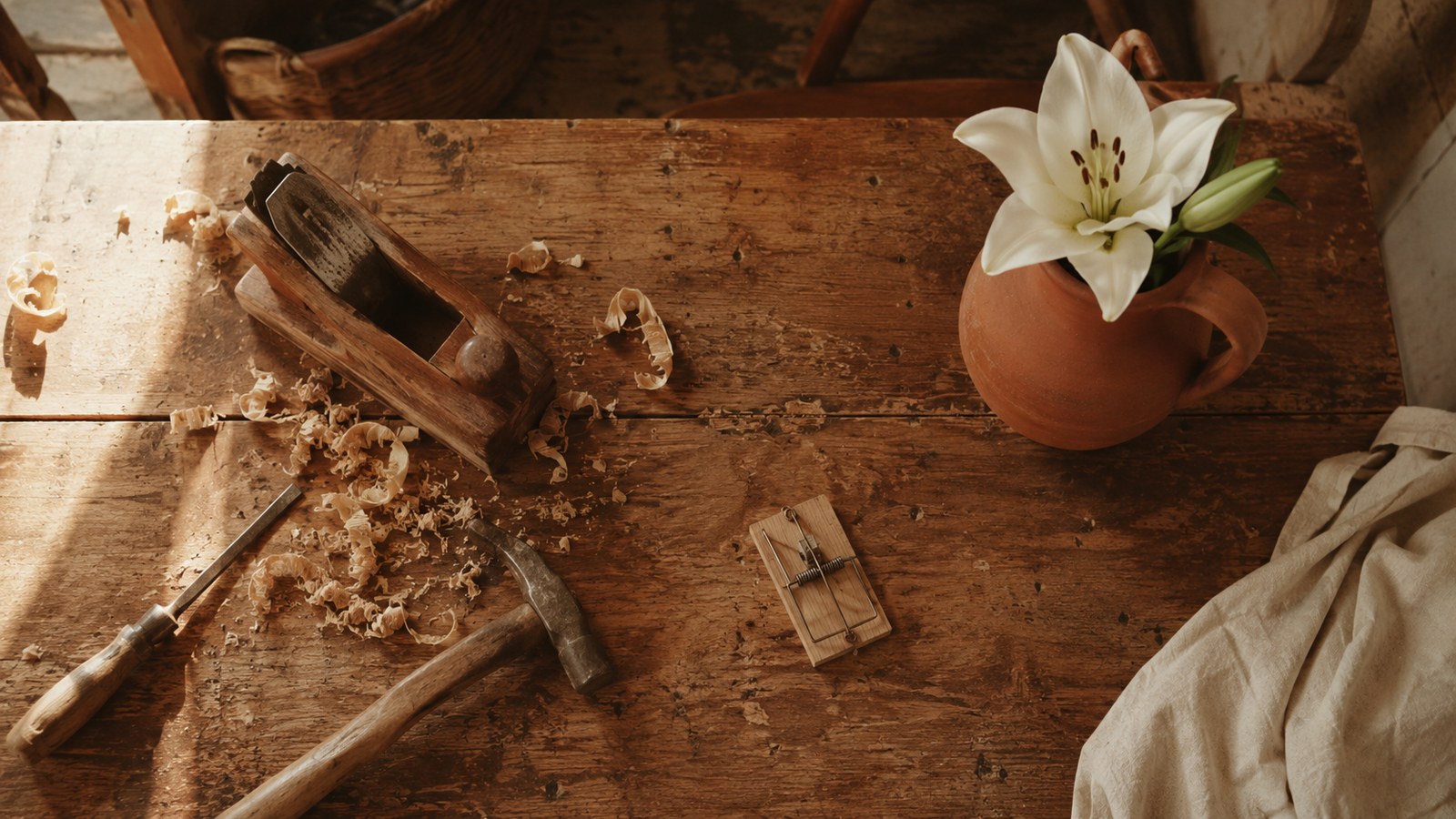
There Is a Mousetrap on the Workbench in a Painting From 1427. It Is There on Purpose.
In the Mérode Altarpiece, painted around 1427 to 1432 by the workshop of the Master of Flémalle, there is a mousetrap in Joseph's workshop.
It isn't set dressing. According to the book, "many objects have symbolic significance: the mousetrap in Joseph's workshop symbolizes Christ's incarnation as a snare for the devil."
Somebody in the fifteenth century put a mousetrap into a sacred picture, knowing exactly why, and expecting whoever looked to understand.
It made me think differently about something I do every December without thinking: choosing what goes on the table.
The radical thing the Flemish painters did
The sentence that sums up the whole movement is short: "in this famous triptych the Annunciation occurs in a Flemish domestic interior."
A sacred scene, moved into an ordinary house, and furnished precisely.
And it wasn't an exception. "Symbolic objects became a feature of 15th-century Netherlandish art", and the style "blended realistic detail with spiritual symbolism."
Two things at once, from the same brush: a room that genuinely exists, and a room in which every item means something else.
From the same altarpiece the book gives a second object with a stated meaning: "the three blossoms of this lily symbolize Mary's virginity before the Annunciation, after conception, and perpetually after Christ's birth."
Three flowers, three tenses. Somebody counted the blooms.
The room that crosses the hinge
This is my second favourite fact and it's a technical feat I didn't know existed.
The Diptych of Maarten van Nieuwenhove, by Hans Memling, 1487, shows the Virgin and the donor in separate panels but in the same room — and the book gives the proof: "both figures are reflected in the mirror behind her."
Two boards, a hinge down the middle, and a painted mirror confirming that the space runs continuously across both.
The painter used an object in the room to prove something about the architecture of the picture itself.
Free
Take the Christmas table checklist
It arrives straight away. After that, my newsletter — leave whenever you like.
The painting everybody over-reads
Here the book gave me a lesson in honesty I'm going to pass on.
The Arnolfini Portrait, Jan van Eyck, 1434, National Gallery, London, "shows a wealthy couple in a domestic interior."
You've probably heard some explanation of the dog, the shoes, the single candle, the mirror. I've heard several.
And the book says this: "scholars debate the painting's subject, and question the extent to which the meticulously painted objects have symbolic significance."
In other words, nobody knows. The most famous painting of objects in a room is also the most argued over, and its symbolic reading is not settled fact.
I could have written a pretty list of meanings here. I'm not going to, because my book gives none, and inventing them would be far too easy.
The most famous winter in painting
Moving from a room to a landscape.
Hunters in the Snow, Pieter Bruegel, 1565, Kunsthistorisches Museum, Vienna, is "one of a series of six paintings of The Months."
A series of six. A whole year divided into six pictures, and this is the cold piece.
The book describes where the type came from: it's "a monumental version of the type of scene that appeared in medieval Books of Hours." The illustrated calendar, which was a small private object, blown up to wall size.
And on the composition: "as hunters trudge through the snow, bold diagonals lead across and into the painting toward icy ponds and distant Alpine mountains."
I won't describe anything else in it, because my book doesn't. If you've seen it, you know there's more going on. I simply have no source for those parts.
And the feast
There's a table painting in the same section, and it's the most December thing I found.
The King Drinks, Jacob Jordaens, around 1640, Musées Royaux des Beaux-Arts, Brussels: "this rollicking scene depicts a popular Flemish Twelfth Night festivity when one participant became 'king for the night'."
King for the night. One person at the table, chosen, with joke authority over everyone else, for the length of a meal.
Two facts about the painter: after Rubens died in 1640, Jordaens became Flanders's leading figure painter, and his style was "much more down to earth."
The book doesn't explain how the king was chosen, and I'm not going to fill that in with the story about the bean in the cake. It doesn't say.
How they managed to paint it
Three technical notes, because technique is half the story.
Van Eyck perfected the use of layers of transparent glazes, to create "luminous, illusionistic effects, brilliant colors, and an enamel-like finish." Layer on layer, each letting light through to the one beneath.
From around 1403, an illumination shows "an artist's assistant grinding pigment into oil with a muller." The manual labour behind any beautiful surface.
And a logistics solution I loved: Dirk Bouts, in the 1450s, mixed pigments with glue directly onto linen — and the reason is purely practical: "the linen support could be rolled and easily transported." A painting that travels rolled up.
The name that isn't a name
A curiosity that closes the circle.
"'The Master of Flémalle' is an invented name for an anonymous artist." The paintings were once mistakenly believed to have come from an "abbey of Flémalle". Most scholars now think Robert Campin, a leading artist in Tournai, painted them. Campin purchased citizenship in Tournai in 1410.
The man who painted the most interpreted mousetrap in art history is known by a wrong address.
What I take to my own table
This isn't about religious symbolism. It's about a choice of method.
Those painters decided that an ordinary room can carry meaning. That you don't need a gold ground or a marble column for a scene to matter. A workbench, a window, a lily and a mousetrap will do.
Three practical things I took from it:
Few objects, chosen. The Mérode interior isn't crowded. Each thing is there because somebody decided.
An object can carry the memory instead of the decoration. A table with four things that mean something to the people sitting at it beats a table with forty things bought together.
An object can prove something about the space. Memling's mirror is exactly that. A mirror, a glass, any reflective surface: they tell the eye where the room carries on.
If you want the rest of what we're writing for the season, I've gathered it on one page. And since the table is the subject of the picture here, the Dutch made the laid table an entire genre.
If you want one more object on the table that costs nothing, the folds are all in the course. R$ 47.00, lifetime access.
Tell me: is there something on your holiday table that means something nobody outside the family would understand? Here it's a chipped jug and the story is long.
Free
Take the Christmas table checklist
Everything that matters on a Christmas table, on a single sheet. Print it, or fill it in on your computer.
It arrives straight away. After that, my newsletter — leave whenever you like.