
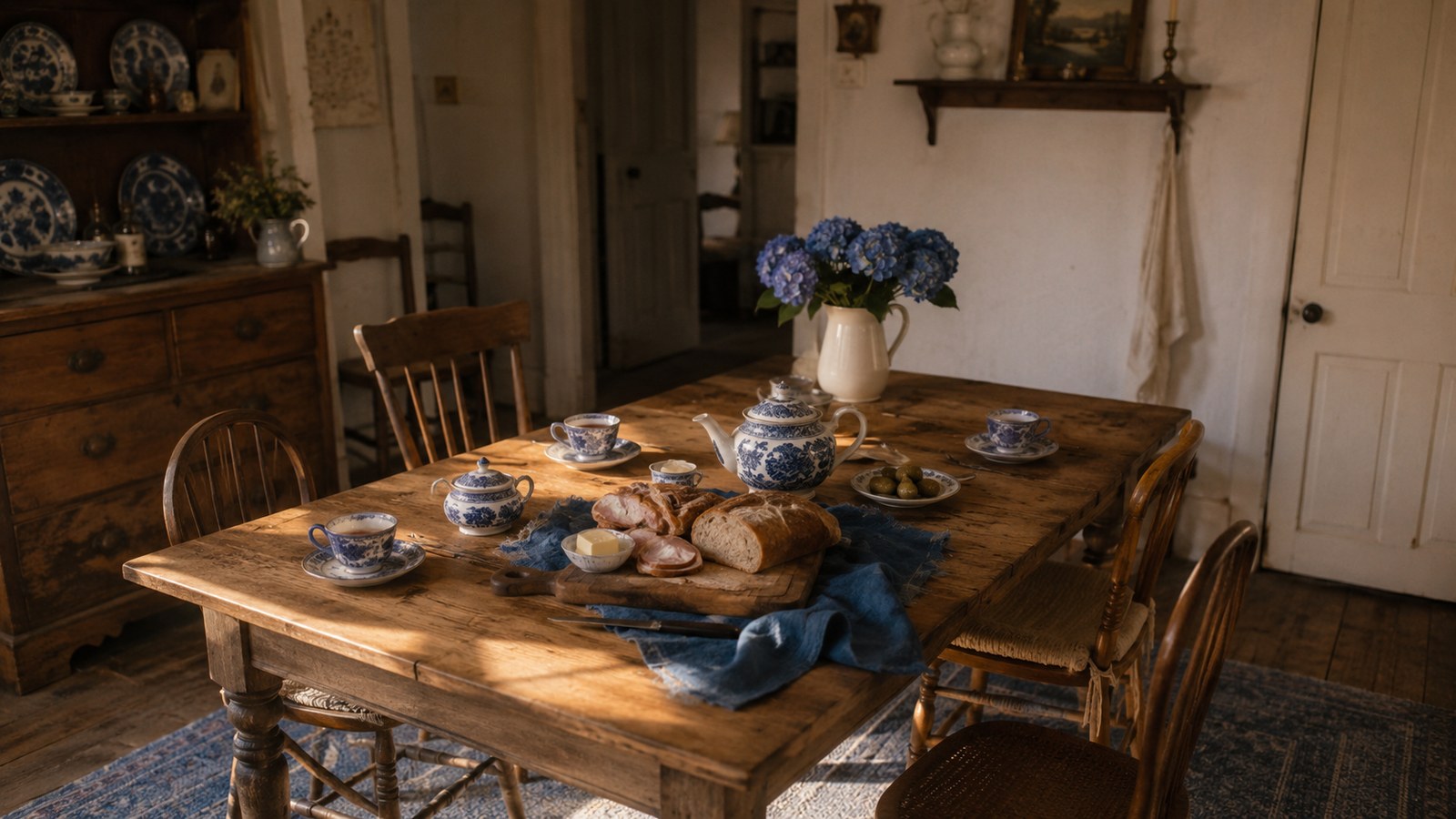
High Tea Isn't the Fancy One. It Was the Working Day's Supper.
Nearly every hotel advertising "high tea" is serving something else. And nearly everyone booking it thinks they've asked for the posh version.
It's the wrong way round.
The "high" in high tea never meant elevated or refined. It meant the hour was high in the day, around six in the evening. It was the meal of people who worked, in England's industrial Midlands, once shops began staying open until eight or nine to serve customers who could only come after their shift. Dinner was pushed too late, so they ate around six: cold meat, bread, whatever was left. It was also called meat tea.
The delicate one, with the little sandwiches and the scones, is the aristocratic one. And it has an inventor, a date and an address.
A hungry duchess, 1840
People ate twice a day then. Breakfast early, dinner between seven and eight in the evening when workers came home. In between, a gap of about ten hours.
In 1840 the Duchess of Bedford started asking for tea around four o'clock in her rooms at Belvoir Castle, simply to get herself to dinner. Then she began inviting friends. And it became an institution.
The first menu was modest: toast and sweet butter, often with cinnamon. Warm scones, jam, crumpets, small sandwiches and pastries came later.
I love that the most elegant thing on the English table began because a woman was hungry at four in the afternoon.
A pause, before this turns into a rule
I'm not telling you this to correct anybody. If you call afternoon tea "high tea", the world keeps turning and the hotel brings the three-tier stand regardless.
Free
Take the Christmas table checklist
It arrives straight away. After that, my newsletter — leave whenever you like.
Choose by the clock, build the menu backwards
This is the most useful thing in the whole history, and it isn't etiquette. It's common sense.
Between three and four, nobody is truly hungry. Light works: small sandwiches, a scone, something sweet. You can even skip plates, since a saucer holds a sandwich and a small cake without drama.
Between five and six, people arrive hungry. Serve real food and put out plates and forks. Pretending a finger sandwich will do at six in the evening is how a host loses the evening.
An invitation usually covers a two-hour window, and guests tend to stay about one. Useful for working out how much food to make.
The tea itself, where most of us slip
A few things, all easy:
- Fresh cold water, brought to a rolling boil. Don't let it boil on and on; the water loses oxygen and the tea turns flat.
- Warm the pot first. A little hot water, swirled and tipped out. It makes a real difference to the brewing temperature.
- Water over the leaves, never leaves dropped into water that's already been poured.
- Use a timer, not your eyes. Whole-leaf black four to five minutes, broken-leaf three, oolong seven, green one to three, a bag thirty seconds. Colour tells you nothing about readiness.
- One level spoon per cup, plus one for the pot. Green tea wants double.
- Weak tea is made by diluting, not by under-brewing. Pour the strong tea and top it up with hot water from the kettle. It's the traditional fix and it's better, because under-brewed tea is watery rather than mild.
And one small thing that solves a small noise: put the spoon on the saucer behind the cup handle before you pour, lying parallel to it. Then it doesn't slide off when someone lifts a full cup one-handed.
If you're serving green tea with lemon and sugar, add the sugar first. The acid from the lemon slows the sugar dissolving.
How to store it, which nobody mentions
Below about thirty degrees, airtight, away from garlic, onions and spices. Tea leaves take on smells with alarming enthusiasm.
Black and oolong keep eighteen to twenty-four months. Green won't go past six. That handsome tin of green tea that's been on your shelf since last year has almost certainly stopped being interesting.
What isn't compulsory
Almost all of it.
Matching china isn't compulsory. A white cloth isn't compulsory. Individual plates, at a genuinely light tea, aren't compulsory. Silver pot, candlesticks, order of service, none of it.
If you've got more than a dozen people, the one trick I'd take seriously is asking two friends to take turns pouring, half an hour each, so you're free to greet people at the door. That one is from the nineteenth century and it still works.
The shortest definition there is
Sen-no Rikyu, the fifteenth-century Japanese tea master, put it like this: "boil water, infuse tea and drink. That is all you need to know."
Everything after that is preference. Including the name.
Do you do afternoon tea at home? I badly want to host one at six in the evening, with cold meat and good bread, and call it high tea with total accuracy.
Free
Take the Christmas table checklist
Everything that matters on a Christmas table, on a single sheet. Print it, or fill it in on your computer.
It arrives straight away. After that, my newsletter — leave whenever you like.